Showing posts with label Hatnuah L'atzmaut. Show all posts

Sunday, February 19, 2023

More on marching back to the Middle Ages

Attention all who are concerned to get a better understanding of the Ministry's March Back to the Middle Ages. I described the process a few days ago.

If you would like to learn about the new legislation which the Ministry of Welfare and Social Justice is proposing, head for this event. Adv. Naama Lerner, CEO of  Hatnuah L'Atzmaut - the Movement for Independence will deliver a zoom lecture. entitled Zero Restraints

It's scheduled for February 19, 2023 at 20:30 Israel time.

Adv Lerner will be addressing these topics::
  1. What is the Israeli reality today in the field of restraint of people with disabilities in frameworks supervised by the Ministry?
  2. What is a non-violent and effective alternative coping approach?
  3. A brief background to the ongoing struggle these days against the Ministry's memorandum of law intended to legalize and anchor the use of restraints.
Here is the link you need to register.

The lecture will be in Hebrew and will be recorded for posting on the organization's Facebook page.

Thursday, February 16, 2023

The Ministry's march back to the Middle Ages

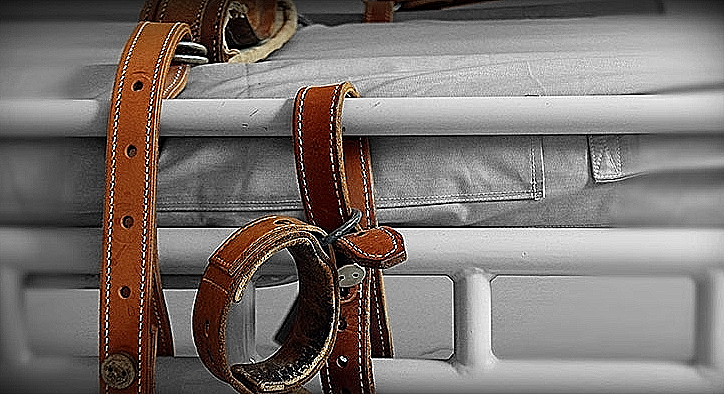
Restraint bed: Illustration from a Disability Rights California guide 
This month, Israel's Ministry of Welfare and Social Affairs (משרד הרווחה והביטחון ההחברתי) announced that it will be enacting a law which will regulate the use of "restrictive protective measures" in institutions for people with disabilities.

The mere phrase sounds alarm bells. 

That is, for anyone concerned about the welfare of our most vulnerable citizens and, of course, for those citizens themselves. 

But, somehow, these words are used acceptingly by most everyone else. That would explain why the infliction of such measures - which include restraint chairs, bed restraints and isolation - has thus far been dealt with only in the Ministry's internal procedures. 

The institutions have enjoyed extremely broad discretion in their use. According to the Ministry's recent memorandum, this practice has "increased the potential for harming the rights of people with disabilities and the staff working in the frameworks".

That new memorandum of the law states that a restrictive protective measure will be defined as one that 
"reduces the movement of a person in space, including the movement of his body, with the aim of maintaining the personal safety of the person or others from actual risk."
Beyond this, it does not specify the restrictive measures that will be regulated. Nor the duration and frequency of their use.

Moreover, once it is enacted, the use of such measures against a person will only be permitted after other options to prevent the danger have been examined and ruled out. The prior approval of professionals as will be stipulated in the regulations will also be required. 

And, finally, the use of these measures will be brought to a re-discussion once every period of time to be determined later.

However - and this creates a huge loophole - the amendment continues:
"In exceptional emergency cases that could not be foreseen in advance, it will be possible to take restrictive protective measures that were allowed to be used in the regulations in emergency cases without prior approval from the authorities, provided that their use is reported as soon as possible to the authority authorized to do so to be determined by the minister."
In other words, whenever the institution's employees deem a situation to be an "emergency" they are free to act as they please. Not surprisingly, advocates for the rights of people with disabilities are outraged by the Ministry's decision. 

Bizchut, The Center for the Human Rights of People with Disabilities, had already submitted a petition to the High Court protesting the use of such measures months prior to the memorandum.

The group's attorney, Vered Bar, now said of the impending amendment that it 
"reflects shocking perceptions regarding people with disabilities. We could not imagine a parallel procedure which allows restrictions regarding any other population."
She added that it 
"will allow the Minister to determine the use of restraints as he sees fit. Those staff members who have been exposed just this past year as having perpetrated violence, abuse and neglect will be the very ones to determine whether a person will be locked up or tied to a chair."
Naama Lerner from Hatnuah L'Atzmaut - the Movement for Independence, an organization working to promote "independent life with personal assistance for every person with a disability in Israel", warned that accepting the memorandum of the law would cast a "terrible stain on the State of Israel".

According to her, the "calming measures" that the Ministry will adopt include
"tying people to a heavy metal chair so that they cannot get up from it and move around or locking people in isolation rooms that have nothing but a thin mattress on the floor."
She explained that "These are means of intimidation, humiliation and abuse.". And noted that after receiving a permit, "it is unlikely that the caregiver in the institutions will comply with the usage restrictions that will be established."

This amendment is propelling us back to the middle ages.

But we may succeed in blocking its enactment by inundating the Ministry with our objections. Here is the link for lodging your complaint. The cutoff date is March 5, 2023

The following (translated by me from the Hebrew original) is an excerpt from the response of a person diagnosed with Autism to the proposed amendment: He is non-verbal and communicates only via his keyboard:
"The thin veil of civility that has covered society since dark times is crumbling. We are a society where there are laws against abuse of the helpless, like in advanced societies in the western world. A person is no longer put in a dungeon just because he looks different and behaves differently... And suddenly, someone in the Welfare Ministry woke up, scratched his scalp and enacted a law that means: the celebration is over. Enough, you've had enough. You are the disease, and we have a cure - punishment for "bad behavior"...  Someone in the Welfare office thinks we are very spoiled and need to be restrained. It was important to him to convey to us the message that life is not therapy but survival. A jungle!" [Source: Shavvim]
Let's not abandon him and others sharing his plight.

Wednesday, December 14, 2022

Institutions grab headlines again

Beit Bar Dror in the Israeli news (December 9, 2022)
Naama Lerner, our local unsung hero ("A woman of valor" December 11, 2022) followed up her one-person protest with the update below. 

It's so shocking it sounds scripted. But trust me, Naama doesn't do that. (The translation from the Hebrew source on Facebook is mine.)
On Friday morning a news report was published about food poisoning at the Bar Dror institution in Kfar Saba. Thirty-six out of the one hundred residents came down with diarrhea, and some of them even had high fevers.

Does this news sound painfully familiar to you? If so, it's because a few months ago a very similar article was published about the Beit Dafna Institute. There it ended with the death of three residents. This time, miraculously, no one paid with his life.

But is this incident any less serious because of that?

A side anecdote. As you remember, last week private institutions held a demonstration in front of the Ministry of Welfare, demanding additional money and standards. Facing them the Movement for Independence placed signs intended to remind the institution managers of the incidents of neglect, abuse and death that occurred in the last year in these institutions, and of their audacity in demanding money and services.

At some point, some of the protesters began to cross the road and attempt to have a dialogue about what was written on the signs. One of the protesters introduced herself as an employee of the Bar Dror Mossad. She was angry that the signs lumped together all the institutions, and claimed that Bar Dror should not be included with the institutions where residents died due to neglect or abuse, since no untoward events had occurred there and it is exemplary..

"Our facility is different," she claimed. "It operates in an exemplary manner".

Less than a week has passed, and the news about food poisoning at the Bar Dror institution has been published. Need another explanation about the inclusion of all institutions under the same umbrella? Who is next in line?"
And now "hot off the press", an update on that update:
Sanitary deficiencies were discovered at the Bar Dror institution, a hostel for people with special needs, in Kfar Saba. The Ministry of Health today (Wednesday) issued an instruction to close the kitchen at the institution after tests of food samples revealed low levels of Clostridium bacteria and E.coli bacteria. Although these levels do not cause illness, they do indicate poor sanitary conduct of the institution." [Source: Walla (Hebrew)]
It doesn't seem like this institution will be excluded from the inclusive list of "bad entities" anytime soon.

And while we are agreeing on that generalization, note that Doron Almog's "babies" (ADI Negev and ADI Jerusalem) are two more such private, large, institutions enclosing people with disabilities from infancy to middle age. 

But that fact is carefully swept under the carpet. Instead, Almog, now head of the Jewish Agency is touted as a champion of the rights of people with disabilities. 

Here is but one example of many such distortions. Since he became chairman of the Jewish Agency, Almog has been promoting a policy of opening up the world of aliyah to all types of Jews in the Diaspora, including those will special needs. As the Jerusalem Post recently wrote: 
This topic is especially close to his heart, as the founder and chairman of the rehabilitation village "ADI Negev-Nachalat Eran" which has become a model for integrating people with disabilities. 

Which brings to mind Abraham Lincoln's words: “You can fool some of the people all the time; you can fool all the people some of the time; but, you can't fool all the people all the time.” 

Some of us are not fooled about Doron Almog.

Sunday, December 11, 2022

A woman of valor

There are surely many unsung heroes among disabilities activists all over the world.
 
We are blessed with one in Israel, Adv Naama Lerner of Hatnuah L'atzmaut (The Movement for Independence): tireless, brave, determined, idealistic, compassionate, intelligent and religious - obviously a rare mix of traits. 

While she's often interviewed by journalists, and has been an activist for decades, she never toots her own horn. Which probably explains her relative anonymity.

Last week Naama exhibited unusual pluck which earned her a few kudos among activists. One person who acknowledged this was former Knesset member, Stav Shaffir. I've mentioned her here before because she organized the surprise visits paid by activists to closed institutions for people with disabilities in December 2018 in which I took part ["Making history: After the raid"].

She paired-up activists with Knesset members to enable us to gain entry to these normally locked institutions. (Note: the institutions are obligated to open their doors only to Knesset members.)

Naama Lerner protests outside Israel's
Ministry of Welfare, December 5, 2022 [Source]
Here - in my translation from the source Hebrew - is what Stav wrote about Naama on her Facebook page this past week:
I want you to meet a very brave woman: Naama Lerner. Yesterday she stood alone opposite the Ministry of Welfare in protest against the private companies that make millions at the expense of people with special needs. 
These companies receive a budget from the state in order to take care of them - but instead of paying a fair wage to the caregivers, they put the money in the management's pocket, and then come asking for more. 
The therapists get discouraged and are replaced, are usually untrained, and the treatment of a person with special needs - is accordingly. 
This year, residents in such institutions died due to food poisoning and in other unknown circumstances.
Naama stood there in front of the office alone, but she is really not alone: she stands on behalf of tens of thousands with special needs. On behalf of families who lost their children (physically or mentally) to institutions that did not treat them properly. 
I learned about her activities in depth when, as a Knesset member, I began conducting surprise visits to these institutions as a member of the Knesset - and I became a fan of her way, of her depth and endless devotion.
This year she founded the Movement for Independence which aims to promote people with special needs to independence in the community, instead of closed institutions. This is a movement in the right direction, operating with almost no resources against huge companies that make billions from the state and maintaining a strong lobby in the government. 
Let's cheer and strengthen her. She deserves it and we all deserve it.

Thursday, October 6, 2022

A shofar message for Doron Almog

Image Source
On August 16, 2022, Doron Almog took the helm of the Jewish Agency.  

Since his nomination for that position, on June 16, 2022, Almog has been hailed as an Israeli hero. Here is the Times of Israel summarizing his claim to that status:   

Almog, 71, a past head of the Israel Defense Forces’ Southern Command, dedicated his life after leaving the military to running a widely lauded rehabilitation village in the Negev desert for people with physical and mental disabilities. ADI Negev-Nahalat Eran is named for his son Eran, who had severe autism and physical disabilities before his death in 2007... [Times of Israel, August 21, 2022]
Since then, hardly a week goes by without a news item about Almog and the Jewish Agency. They have all been unadulterated hagiographies. And occasionally when no such report appeared, he - or his staff - seem to have produced their own. 

So it's fair to predict that some will be enflamed by what I have to say about him.

Almog oversees two large, closed institutions (one of which he founded) named ADI, for people with disabilities ranging from infancy to young adulthood. Its motto: "It’s all in the name: ADI celebrates ability at every level, promotes diversity and insists on inclusion."

He does so despite growing global opposition to institutionalization of this population. 

And he does so despite the recent passage of a new Israeli law that, once implemented, promises to begin the mass transfer of people with disabilities out of the sort of warehouses that Almog champions.

One would have hoped that Yom Kippur and the self examination it encourages would stir Almog to reconsider this major "life achievement" of his. It doesn't seem so when you read his latest op ed, replete with content like this:

"After honoring my late brother Eran who was killed in battle during the Yom Kippur War and my late son, Eran, who was born with severe disabilities, my life philosophy has always been to never leave anyone behind. This applies to my approach regarding aliyah as well. That is because how we treat the vulnerable among us reflects our morality as a society... The absorption of olim should be a national responsibility... We must continue to work, in accordance with the government of Israel, to reunite families and bring olim home, no matter where they are in the world. It is also our obligation to ensure that Ethiopian olim become the absolute best version of themselves. It is what they deserve and what Israeli society needs." ["A full-circle journey: Bringing Ethiopian Jewry home", Times of Israel Blogs, September 28, 2022]

I would remind Almog that much of what he promises to deliver to our new olim has never been provided to our "most vulnerable" as he refers to our population with disabilities.

"Absorption", "reuniting families", is also a national obligation toward those with disabilities who are taken from their families and locked up in large, isolated, closed institutions because the government refuses to provide for their needs at home.  

I am not alone in this assessment. 

Recently an employee at ADI Negev visited (infiltrated?) one of the Whatsapp groups in which I am active. It's designated for people with disabilities, their families and activists in the field.  She said she was soliciting employment as an aide for people with disabilities. But she added her view of ADI Negev: 

"I am referring to ADI Negev, the Rehabilitation Village, a wonderful place for any age with one on one projects and programs." [My translation of the Hebrew source]

And after she received negative responses re ADI, she wrote:

"First of all I didn't request opinions about ADI Negev. The place is not a fortress. It is actually a village, suitable and pleasant for residents happy with many programs and choice and they create gift (sic) and go out and more. I am only asking that if any of you are seeking a worker, for independence with individuals, approach me." [Again, my translation from Hebrew]
Naama Lermer, a disabilities-rights attorney and founder of Hatnu'ah L'atzma'ut ("The Movement for Independence") and formerly of Bizchut, then posted to the same Whatsapp group in response [again my translation of the Hebrew source]:
I know ADI Negev well. I visited there more than once . It's an institution in every sense of the word. Many groups of residents with disabilities. With a uniform daily schedule. Without any real connection to the community. Some of them are cut off from their families because their families live very far away. People who won't experience what it's like to lick an ice cream in an ice cream shop in the mall. To buy clothes in a clothing store. To get on a train and see the view. Adults who spend most of the day sitting with construction games or children's toys. And it's sad. I wouldn't want to live like that. I wouldn't want my children to live like that. So I don't wish that on anyone else. I want more than creative works and children's games for them. I want more than a clean, tidy place. I want a real life for them. Even if their disabilities are very present."

Many of us have just heard the shofar blown at the close of Yom Kippur prayers. In his New York Times op ed this week, the former chief Rabbi of Moscow, Pinchas Goldschmidt, wrote:

And this is perhaps what the shofar, the ram’s horn that Jews blow on the High Holy Days, represents. According to the Bible, the shofar blow is the sound of freedom. It was historically blown at the beginning of the jubilee year — the year that freed all slaves and returned all sold ancestral property. The sound of the shofar blow is meant to remind us of both freedom and equality.

Let's hope that message will reach those, like Almog, who persist in their perversion of "freedom and equality" to include the warehousing of citizens with disabilities in institutions.